
Donald Cargill
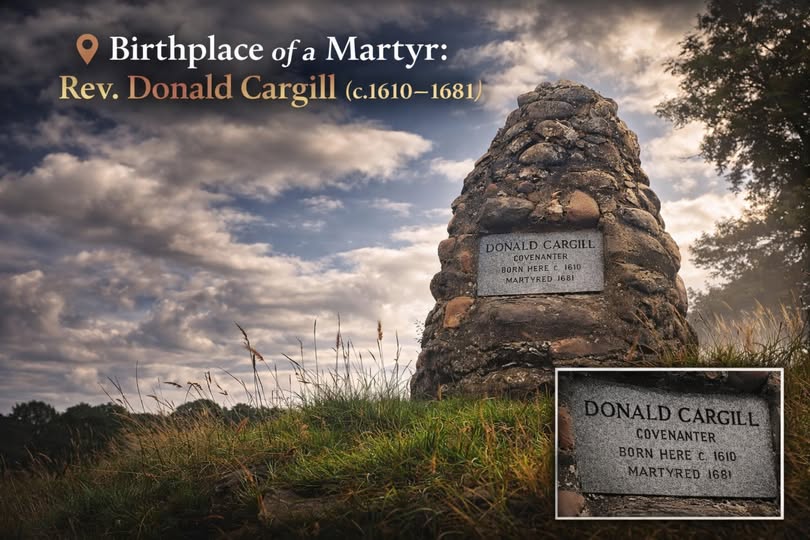
This quiet spot at Blairgowrie and Rattray marks the birthplace of Rev. Donald Cargill — one of the great figures of the Scottish Covenanters.
Educated at the University of St Andrews, he immersed himself in the writings of John Knox and Andrew Melville, but it was his tutor, Samuel Rutherford, who most deeply shaped his faith and resolve.
In 1655, Cargill became minister of the Barony Church in Glasgow. But following the Restoration of Charles II, his fearless preaching against the king soon made him a marked man. Forced into hiding, he continued to preach in the open fields, risking his life to proclaim the gospel.
After the Covenanters’ victory at Drumclog, Cargill hurried to join those gathering for battle at Bothwell Bridge. There he was badly wounded and left for dead. Remarkably, he survived, escaped to Holland for a time, and later returned to Scotland to resume field preaching alongside Richard Cameron. After the death of Richard Cameron, Cargill was the only field preacher left in Scotland.
Cargill preached Cameron’s funeral sermon, and soon after led a large meeting at Torwood, where — in the name of Jesus Christ — he formally excommunicated King Charles II, the most severe censure the church could pronounce.
From that moment, the government relentlessly hunted him. A reward was offered for his capture, dead or alive. He was finally seized in July 1681, condemned for treason, and hanged in Edinburgh.
On the eve of his execution, Cargill wrote these remarkable words:
“This is the most joyful day that I ever saw in my pilgrimage on earth. My joy is now begun, which I see shall never be interrupted.”
Certain that his sins were forgiven through Christ, Cargill faced death without fear. His peace and courage left a deep impression on those who watched — especially an 18-year-old witness named James Renwick.