
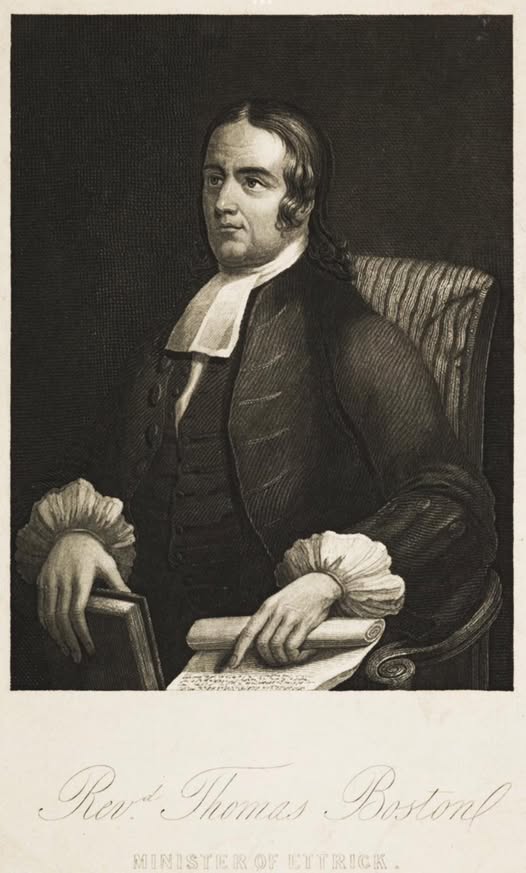
Thomas Boston
Born on this day, 17th March 1676, Thomas Boston.
Thomas Boston (1676–1732) is best known as the minister of Ettrick, author of Human Nature in Its Fourfold State, and one of the key figures in the “Marrow Controversy”.
But did you know as a child he was imprisoned?
During the persecution of the Covenanters, Thomas’s family suffered for their non-conformity to Episcopacy and bishops. His father John spent time in prison for this and at one point young Thomas was also imprisoned with him. But Thomas was not deterred, in fact later on he often rejoiced that he had “been honoured to have fellowship with his father in his suffering”.
Despite prison, once they were released Thomas continued to attend the Covenanters field services with his father. In the summer of 1687, 12 year old Thomas went with his father to hear Rev Henry Erskine preach at Whitsome. There, under gospel-centred preaching, his heart was awakened and drawn to Christ. Two sermons especially marked the turning point in his conversion. The first was from Matthew 3:7: “O generation of vipers, who hath warned you to flee from the wrath to come?”. The second was from John 1:29: “Behold the Lamb of God.” Through these messages, Boston came under deep conviction and began earnestly seeking a saving interest in Jesus Christ. From that time, he said the Lord’s Day became “especially precious” to him.
After studying at Edinburgh University and several unsettled early jobs, he was ordained at Simprin in 1699 and moved to Ettrick in 1707, where he spent the rest of his ministry.
Boston was known as an exceptionally diligent pastor. He preached frequently, visited every household in his parish twice a year, and remained faithful to his duties despite poor health, personal grief, and family hardship. He and his wife, Katharine Brown, had ten children, but six died young, losses that marked him deeply.
His larger importance came from theology and church controversy. He opposed the abjuration oaths because they seemed to endorse episcopacy, challenged the heresies of John Simson, professor of divinity in the University of Glasgow and became a central figure in the Marrow controversy, where he defended ideas associated with Edward Fisher’s “The Marrow of Modern Divinity”. Although the Church of Scotland condemned the Marrow, Boston’s role in the controversy helped make him widely known.
His best-known book, Human Nature in its Fourfold State, became one of the most widely reprinted Scottish books of the eighteenth century and strongly influenced evangelism in Britain and America.
He died in 1732, still carrying out pastoral work to the end, even preaching his final sermons from his deathbed to parishioners gathered outside his window. He is buried in Ettrick Kirkyard.