
On this day in Covenanting History
As well as the important figures in Scotland’s Reformation and Covenanter history, we also think it’s important to remember and keep alive the stories of those perhaps not so well known.
Like a theology student by the name of John Dick who was martyred in Edinburgh on this day, 5th March 1684.
In the early hours of 16 September 1683, twenty-five prisoners broke out of the Canongate Tolbooth.
The escape was possible because the Jailer didn’t stay overnight. Each evening he locked the Tolbooth and went home, leaving the prisoners to their own devices. Somewhere along the way, a saw was smuggled inside, and night after night the men worked patiently at the iron bars, cutting bit by bit in the dark. At last, on that September night, they sawed clean through and slipped out.
For a moment, though, the whole plot almost collapsed. One of the severed bars dropped onto the street below with a sharp clang, echoing through the stillness. It was the kind of sound that should have brought a watchman running—but somehow, no one came.
Most of the escapees were not Covenanters; some were imprisoned simply for debt. But a few of those who fled were Covenanters, including John Dick, a theology student who had fought at Bothwell Bridge.
John had been captured the previous month and sentenced to death, with the execution set for 28 September. His escape came just in time to save him from the scaffold—at least for a while.
His freedom, however, lasted only about six months. Of all the men who broke out that night, he was the only one ever recaptured.
He was brought to a new trial on 4 March 1684 and charged that he confessed and believed that:
1) He had been at Bothwell in arms, and owned it as lawful.
2) That episcopacy was unlawful, and the laws establishing the same.
3) That since the restoration, there hath been no free parliament.
4) That episcopacy and erastianism since established, are contrary to the word of God.
5) That the supremacy, as established, is most horrid blasphemy.
6) That persons assaulted at conventicles may defend themselves.
7) That field conventicles are lawful, and turning out presbyterian ministers, unlawful.
8) That the covenants are binding, and the test is an un lawful oath.
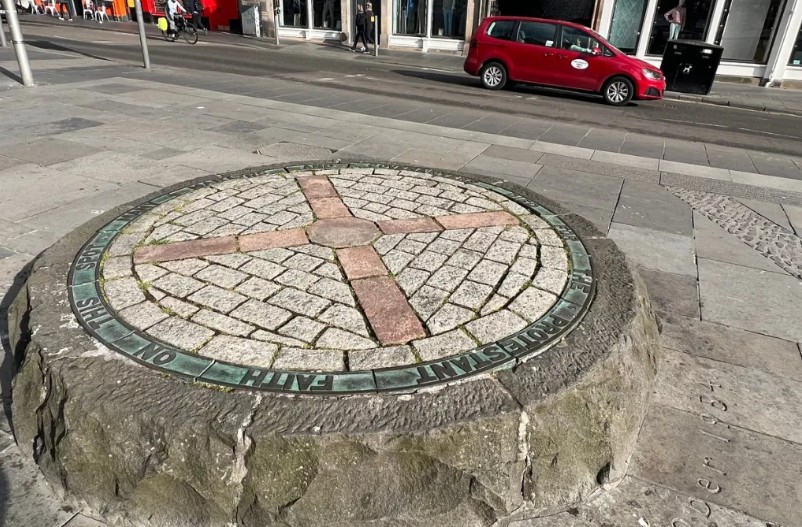
Being found guilty of high treason, he is condemned once again, this time to be hanged the following day at the Grassmarket.
On the 5th March, as he stood on the gallows he said:
“I am come here this day, and would not change my lot with the greatest in the world. I lay down my life willingly and cheerfully for Christ and His cause, and I heartily forgive all mine enemies. I forgive all them who gave me my sentence, and them who were the chief cause of my taking; and I forgive him who is behind me (the executioner.) I advise you who are the Lord’s people, to be sincere in the way of godliness; and you who know little or nothing of the power thereof, to come to him, and trust God, he will not disappoint you. I say trust in the Lord, and he will support or strengthen whatever trouble or affliction you may meet with. I remember, when Abraham was about to sacrifice his son, Isaac said, ‘Here is the wood and the fire, but where is the sacrifice?’ now blessed be the Lord, (placing his hand on his chest) here is the sacrifice, (pointing to the gibbet) Here is the altar (and pointing to the ladder), here is the wood.”
Then, with the rope already tight at his neck, he raised his voice one final time: “Now, I can hardly get speaking for the rope about my neck, farewell all friends and followers of Christ, and again, I say, farewell and adieu all earthly enjoyments..” He gave the hangman the agreed sign, prayed briefly to himself, drew a napkin over his face, and said:
“Farewell all friends in Christ, and into thy hands, O Lord, do I commit my soul.”
And with that, the hangman carried out his duty.