
Today in Covenanter History
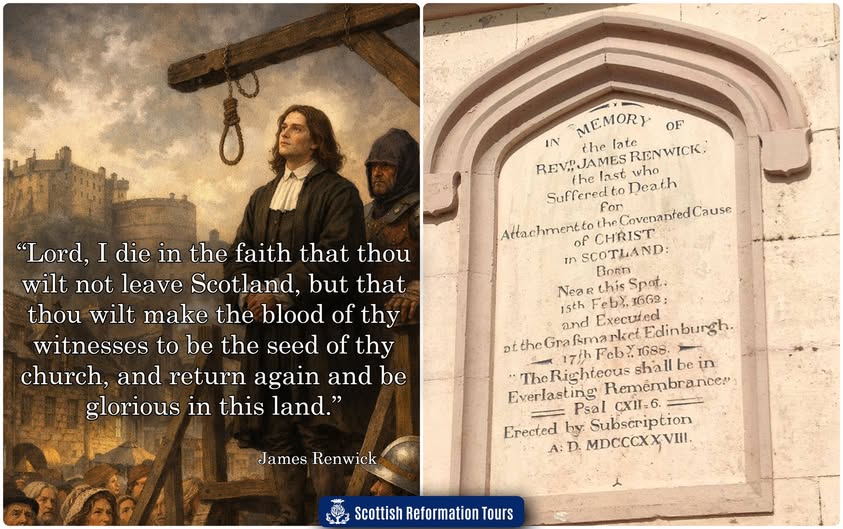
On 17th February 1688, in the Grassmarket of Edinburgh, a young minister—only twenty-six years old—walked calmly toward the gallows. He was the last of Scotland’s Covenanter ministers to be martyred. His name was James Renwick.
Those who stood near him that morning heard something astonishing. Instead of trembling, instead of pleading, Renwick declared:
“I am shortly to appear before the King of kings, and Lord of lords, who will shortly pour contempt on all the kings of the earth who have not ruled for him.”
To the rulers who condemned him, this was defiance.
To the faithful watching, it was hope.
Before ascending the ladder, he sang Psalm 103 and read Revelation 19. Then he prayed, committing his soul to the Lord through the Redeemer and asking that Christ would vindicate His own cause “in his own time.”
And then came words that stunned even his enemies:
“This is the most joyful day I ever saw… I bless the Lord for the honour of the crown of martyrdom—an honour the angels are not capable of.”
To Renwick, death was not defeat. The scaffold was not shame. It was honour.
He regretted only that he was being disturbed in worship. “But by and by,” he said, “I shall be above those clouds, and enjoy, and worship, and glorify thee without interruption for ever.”
When allowed to speak to the crowd, he did not soften his testimony.
“I am come here this day,” he said, “to lay down my life for adhering to the truths of Christ, for which I am neither afraid nor ashamed to suffer.”
He declared that he died for three things:
1) For disowning the usurpation and tyranny of James, Duke of York.
2} For preaching that it was unlawful to pay cess
3) For teaching that it was lawful for people to carry arms, for defending themselves in their meetings for receiving persecuted gospel ordinances.
Then came words of remarkable conviction:
“I think a testimony for these is worth many lives; and if I had ten thousand, I think all little enough to lay down for the same.”
He continued by affirming the Word of God as the only rule of faith and life. He owned the Confession, Catechisms, Covenants, all the faithful contendings that have been for the covenanted reformation. He continued by saying he left his testimony approving preaching in the fields, and the defending the same by arms and attaching it to the others that have been “sealed by blood, in scaffolds, fields, and seas.”
He left his testimony against popery, prelacy, Erastianism, and every encroachment upon Christ’s royal rights.
And even on the edge of eternity, Renwick thought of others.
To believers he urged:
“Ye that are the people of God, do not weary in maintaining the testimony of the day… make sure an interest in Christ, for there is a storm coming, which will try your foundations.”
To the unconverted he spoke with solemn urgency:
“Break off your sins by repentance, else I will be a sad witness against you in the day of the Lord.”
When ordered to finish, he replied simply, “I have near done.”
At the top of the ladder he prayed again:
“Lord, I die in the faith that thou wilt not leave Scotland, but that thou wilt make the blood of thy witnesses to be the seed of thy church, and return again and be glorious in this land.”
He believed Scotland would yet see better days.
As the napkin was tied around his head, he whispered to a friend:
“Farewell, be diligent in duty, make your peace with God, through Christ. There is a great trial coming as to the remnant I leave. I have committed them to God. Tell them from me, not to weary, nor be discouraged in maintaining the testimony. Let them not quit or forego one of those despised truths. Keep your ground, and the Lord will provide you teachers and ministers, and when he comes, he will make all those despised truths glorious upon the earth.”
And then came his final words:
“Lord, into thy hands I commit my spirit, for thou hast redeemed me, O God of truth.”
James Renwick was the last Covenanter minister executed in Scotland. Within months, the political storm he foresaw would break. The Revolution of 1688 would sweep away the very powers that condemned him.
But Renwick did not live to see that change.
His confidence was not in political deliverance but in Christ’s unshaken throne. He believed that “the blood of thy witnesses” would indeed be the seed of the church.
(Image of the Renwick Monument at Moniaive.)