
On this day, 6th July 1560…
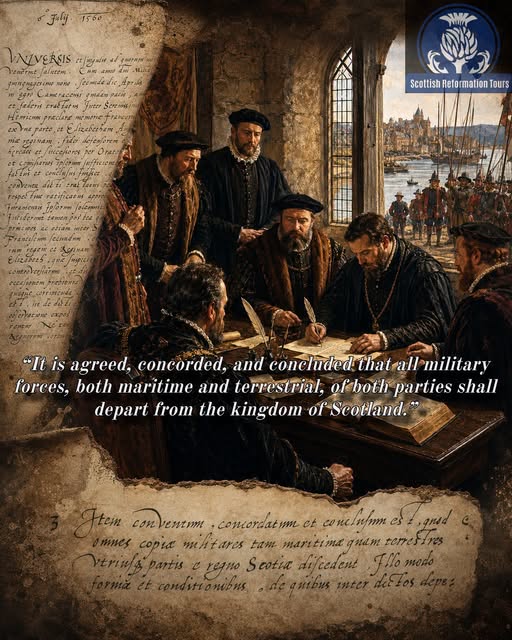
On this day, 6 July 1560, one of the most important political events of the Scottish Reformation took place: the Treaty of Edinburgh.
This treaty helped change the future of Scotland.
John Knox had returned from Geneva in 1559 to help lead the Scottish Reformation. By 1560, the Protestant Lords of the Congregation and their forces were being aided by English troops sent by Elizabeth I. Together, they had been resisting the power of the Roman Catholic regency government of Mary of Guise, the French-born mother of Mary, Queen of Scots. Her government was backed by French troops, who were now occupying the harbour town of Leith.
The combined Scottish and English Protestant forces laid siege to the town. Leith was heavily fortified, and the siege became one of the defining moments of the Reformation crisis.
It was bloody, and many hundreds of Scottish and English troops died during one attempt to storm the town.
However, in June 1560, Mary of Guise died at Edinburgh Castle. Her death demoralised the French troops, and hunger was growing in Leith as supplies ran low.
The Treaty of Edinburgh brought that crisis to a turning point.
Under the terms of the treaty, both French and English forces were to leave Scotland. This was crucial. With the French military presence removed, the Reformers were no longer facing the same foreign-backed power that had threatened to crush the Protestant cause.
The way was now open for the famous Reformation Parliament of August 1560.
Within weeks, that Parliament would reject the authority of the Pope, abolish the Mass, and approve a Protestant confession of faith. Scotland was being transformed and John Knox’s vision of a Reformed Kirk in a protestant Scotland was becoming a reality.